How SlowPace was built
111 Days, Brutal Treadmill Feedback, and Why I Scrapped My App's UI Before Launching 3.0
By Harish Naidu, SlowPace founder
If you build software in isolation, you fall in love with your own ideas and designs. If you test it on a treadmill at 145 beats per minute, you find out how many of them get in the runner's way.
Over the past 111 days, I built SlowPace, a real-time heart rate and cadence coaching app, solo, from scratch, across iOS, watchOS, Android and Wear OS. Along the way, I had to throw out my entire user interface, work out how to make a watch coach a run with no phone nearby, and stop tying the app to any single piece of hardware.
Finding the Real Problem
When I released the first version, close friends downloaded it and immediately asked why there was so much text, and didn't Strava already do this. Looking closely, I realized runners have great tools for sharing a run afterwards and for planning the months ahead. What I wanted, and couldn't find done the way I wanted it, was help during the run itself, second by second: keeping both heart rate and cadence in zone on an easy Zone 2 run.
There are heart-rate apps, cadence apps, and metronome apps that play a timed beat without knowing what your feet are doing. I didn't know of one that put them together: an app that reads your heart rate and your actual steps, coaches both by voice, gives you a metronome to run to, paces your breathing to your steps, and lowers your music whenever the coach speaks. So that is what I built.
Early peer testers on Google Play were too polite. Real honesty came later. One person told me the interface looked like an AI wrote an essay on the screen. Another squinted at his phone mid-run on a treadmill and told me the numbers were impossible to read while moving.
They were right, and it stung. What kept me going was my niece. She had liked the idea from the start, and her enthusiasm carried me through the days when the reviews had flattened mine.
Developer-friendly screens fail runners under physical exertion. I preserved the coaching engine, scrapped the entire UI, and spent two weeks rebuilding it from the ground up, replacing paragraphs with high-contrast glanceability: two big numbers, heart rate and cadence, and one status word. Everything turns green the moment both lock into your target zone.
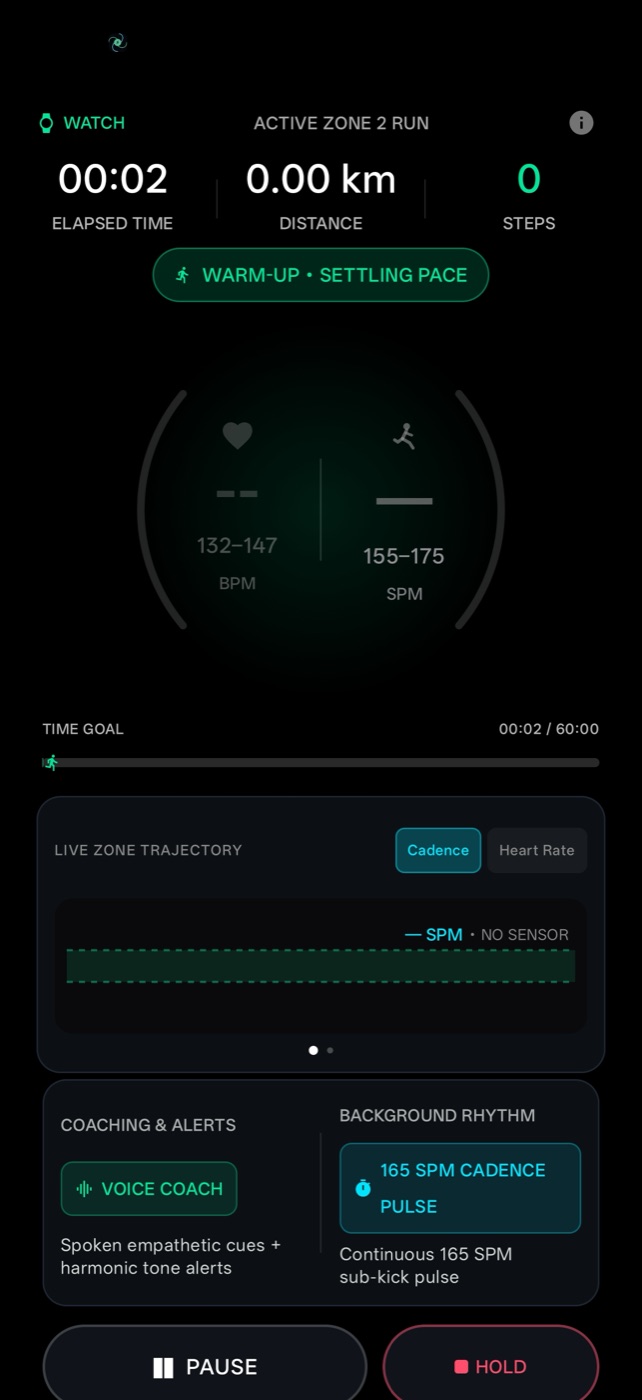
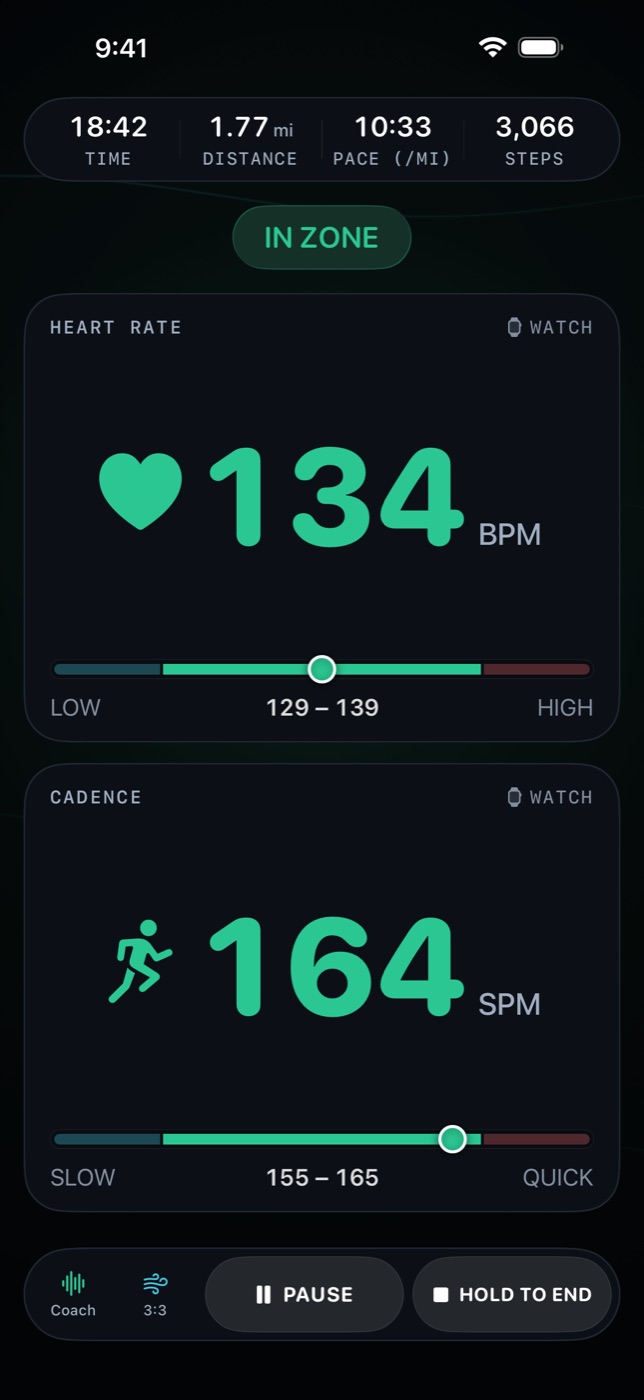
The run screen wasn't the only thing in the way. A neighbour downloaded the app and was overwhelmed before he ever reached it: the setup asked too much, too soon. He suggested a simple video. I tried that, and tinkered for two more weeks, and ended up somewhere simpler still: three pages. One tells you what SlowPace does. One works out your Zone 2. One asks for the permissions it needs. Then you run.
Going Fully Standalone
A friend in India tested an early Apple Watch Ultra build and pointed out a major flaw: the watch was just beaming audio and calculations from the phone, and it lacked split announcements. That feedback triggered an architectural shift. A runner shouldn't need to carry a phone to get coached. I rebuilt the engine so SlowPace runs standalone on Apple Watch and Wear OS. Pair your earphones directly to your watch and get voice coaching straight in your ears, with no phone and no internet connection.
Getting cross-platform cadence accurate without external hardware was the hardest technical hurdle. Phone accelerometers and watch sensors behave wildly differently. For two weeks, I stepped outside more than ten times a day for field-test walks and jogs, and logged multi-day runs, until the custom cadence algorithm held steady across devices.
Heads-Up Display & Any Sensor You Own
By then the voice coaching worked, in 12 languages, and the phone and the watch worked together. But on one field test I noticed something: I still kept lifting my wrist or looking down at the phone, and every time I did, it broke my running form. I wondered if there was a better way.
That got me thinking about heads-up displays. I researched the companies making smart eyewear and cold-emailed them. One French brand replied within four hours and sent me a pair to develop with, and I was able to build the integration in time for 3.0. SlowPace now shows your live heart rate and cadence in your line of sight on their glasses, and I'm exploring the same for other displays.
The sensors came from a conversation too. A colleague who wears both an Apple Watch and a WHOOP told me that if I wanted runners in Dubai to use the app, it had to work with WHOOP. That sent me down the path of Bluetooth, and made me realize that locking the app to Apple Watch or Wear OS left a lot of runners behind. SlowPace now reads any Bluetooth heart-rate sensor that uses the standard profile (I've tested WHOOP and Fitbit Air; Polar, Garmin and Wahoo chest straps use the same standard) and Bluetooth foot pods for cadence.
Privacy First & AI-Ready Data
Everyone uses AI for everything today, and I wanted to support that without giving up privacy. SlowPace requires no account and no login, and your runs are stored on your device. It sends anonymous usage statistics and crash reports; nothing else leaves unless you choose it.
So the AI part is an export, not a service. A single tap copies your run history as JSON to your clipboard, alongside a ready-made prompt, and you can analyze your runs in whichever AI tool you already use. The app's own post-run analysis is built in as well: heart rate drift, meters per heartbeat, a color-coded map you can scrub through, and Strava upload, which is opening up to early users.
What Comes Next
My niece also came up with our first marketing idea: T-shirts with a QR code to the App Store on the back, worn at local running events. We did it for fun. It was fun. It did not bring in a single extra download.
That is the honest state of things. The app is built. Getting it in front of runners is a different job, and it is the one I plan to spend the next 111 days, or more, working on.
SlowPace isn't built to turn your runs into a social feed. It is built to keep you in your aerobic zone, respect your privacy, and get out of your way. The first 5 guided runs are free. Download 3.0, pair whatever sensor you already own, and enjoy the run.